Key takeaways
- MOTS-c is a 16-amino-acid peptide encoded in the mitochondrial genome, not the nucleus.
- It was described in 2015 by researchers at the University of Southern California [1].
- In that work, its main target tissue appeared to be skeletal muscle, acting through the folate cycle and AMPK [1].
- It is studied in metabolic-regulation and ageing research models.
At a glance
| Name | Mitochondrial open reading frame of the 12S rRNA-c |
|---|---|
| Length | 16 amino acids |
| CAS number | 1627580-64-6 |
| Molecular formula | C101H152N28O22S2 |
| Molecular weight | 2,174.6 g/mol |
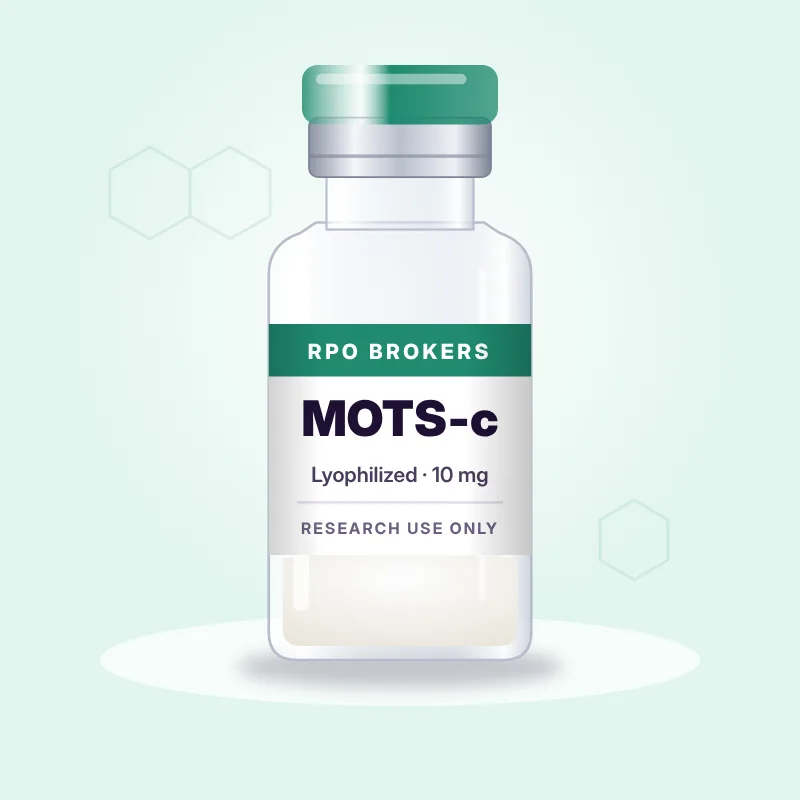
| At RPO Brokers | MOTS-c · 10 mg and 40 mg |
Why a mitochondrial peptide is unusual
Almost all of the body’s proteins are encoded in the cell nucleus. Mitochondria carry their own small genome, and MOTS-c was found as a short open reading frame inside the mitochondrial 12S rRNA gene. It was only the second mitochondrial-derived peptide reported, after humanin [1].
What the founding study reported
In the 2015 Cell Metabolism paper, MOTS-c acted mainly on skeletal muscle in mice. It inhibited the folate cycle and linked purine synthesis, which led to activation of AMPK, a central energy sensor. Treated mice were protected against age-related and high-fat-diet-induced insulin resistance and against diet-induced obesity [1].
Shop MOTS-c MOTS-c lab reports
Frequently asked questions
Is MOTS-c the same as humanin?
No. Both are mitochondrial-derived peptides, but they are different sequences encoded at different places in mitochondrial DNA.
Is MOTS-c sold for human use?
No. RPO Brokers supplies MOTS-c strictly for laboratory research. It is not for human or veterinary use.
References
- Lee C, et al. The mitochondrial-derived peptide MOTS-c promotes metabolic homeostasis and reduces obesity and insulin resistance. Cell Metab. 2015;21(3):443–454. doi:10.1016/j.cmet.2015.02.009
This article is for educational purposes about laboratory research. It is not medical advice. Products mentioned are sold for research use only.